Join the Newsletter
Sign up below to get our Newsletter with educational resources, activities, tips, tricks, and training to help parents, teachers, and care givers engage your students.

www.TheChristieGreen.com
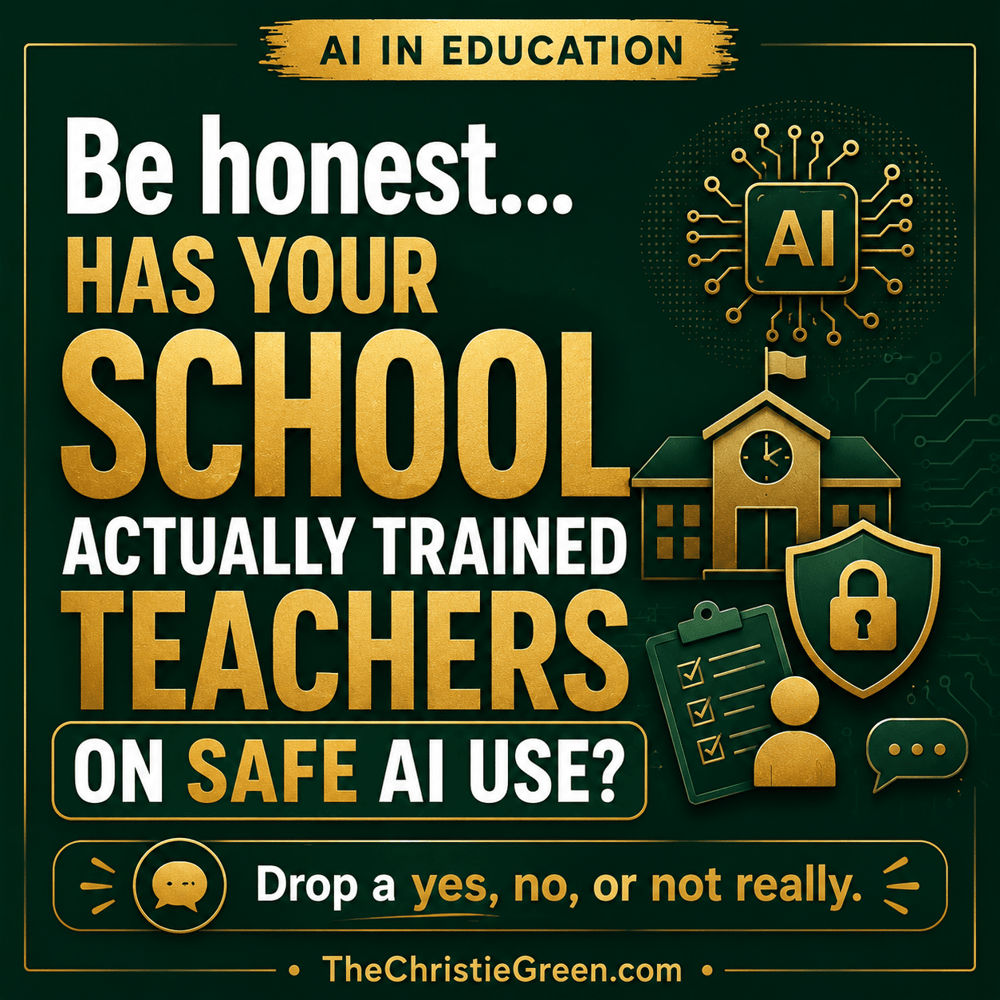
Be Honest… Has Your School Actually Trained Teachers on Safe AI Use?
Monday, May 25, 2026
AI IN EDUCATION • SAFETY • LEADERSHIP • ETHICS
Giving teachers access to AI is not the same as preparing them to use it safely, ethically, and confidently.
Quick Answer
Many schools are giving teachers access to AI tools without providing meaningful training on student privacy, ethical use, safe prompting, hallucinations, family communication, or responsible classroom implementation.
Schools do not need panic. They need proactive leadership, practical training, and thoughtful systems that help educators feel supported instead of overwhelmed.
A Teacher Opens ChatGPT After a Long Day
It is 8:47 PM.
A teacher is sitting at the kitchen table trying to answer emails while finishing tomorrow’s lesson plans.
One student is struggling academically. Another parent is upset. An administrator wants data by morning. And somewhere between exhaustion and survival mode, the teacher opens ChatGPT hoping maybe… just maybe… this tool can help lighten the load.
This scene is happening in schools all across the country right now.
And honestly? Most educators are not trying to misuse AI.
They are trying to stay afloat while still doing right by kids.
Access Is Not the Same as Training
Many schools have already introduced AI into their buildings in one form or another.
Teachers are encouraged to “try AI.”
Districts purchase licenses.
Staff hear about ChatGPT during professional development.
AI tools quietly appear inside educational platforms.
But when teachers ask deeper questions, the guidance often becomes unclear.
“Can I upload student work into this?”
“What should I say if a parent challenges AI use?”
“Is this FERPA compliant?”
“What happens to the data?”
Too many educators are being handed powerful tools without meaningful support on how to use them safely.
That is not a teacher failure.
That is a leadership gap.
Schools Need Proactive Leadership, Not Reactive Leadership
One of the biggest mistakes schools can make right now is waiting until something goes wrong before creating systems.
A teacher accidentally uploads sensitive information.
A deepfake incident appears.
A family becomes upset about AI use.
Then everyone scrambles to respond.
But leadership in the AI era cannot afford to stay reactive.
Schools need thoughtful, proactive leadership that prepares educators BEFORE problems happen.
Proactive AI Leadership Looks Like:
Many schools are giving teachers access to AI tools without providing meaningful training on student privacy, ethical use, safe prompting, hallucinations, family communication, or responsible classroom implementation.
Schools do not need panic. They need proactive leadership, practical training, and thoughtful systems that help educators feel supported instead of overwhelmed.
- Clear AI guidelines for staff
- Clear boundaries around student data
- Conversations about ethics and bias
- Ongoing coaching and support
- Family communication plans
- Safe prompting examples
- Simple teacher training
- Approved privacy-safe AI tools
Teachers Should Not Have to Figure This Out Alone
Most educators are not looking for shortcuts.
They are looking for support.
They want tools that help them:
differentiate instruction
save time on repetitive tasks
support struggling learners
communicate more clearly
reduce burnout
But teachers should never have to guess:
what should never be uploaded
which tools are compliant
how to identify hallucinations
how AI bias impacts students
how to answer concerned parents
what ethical use actually looks like
That kind of uncertainty creates stress, inconsistency, and risk for everyone involved.
AI Is Not Going Away — And That Is Not Necessarily Bad
AI Is Not Going Away — And That Is Not Necessarily Bad
AI can absolutely help schools.
Used thoughtfully, it can:
support lesson planning
help teachers brainstorm ideas
assist with differentiation
make materials more accessible
reduce administrative overload
support creativity and problem solving
But schools must stop treating AI like a trendy app and start treating it like what it actually is:
Because this is no longer just about technology.
It is about:
student safety
family trust
teacher support
ethical responsibility
critical thinking
human connection
Recommendations for School Leaders
1. Create a “Never Upload” List
Teachers need clear examples of what should never be entered into public AI tools, including student names, IEP details, behavioral notes, grades, and identifying information.
2. Train Teachers Before Problems Happen
Do not wait for a privacy incident or parent complaint. Offer practical, real-world AI training proactively.
3. Use Plain Language With Families
Families deserve honest communication about how AI is being used and what protections are in place.
4. Keep Humans at the Center
AI should support professional judgment — not replace it.
5. Build a Culture of Questions
Teachers should feel safe asking questions about AI without fear of embarrassment or punishment.
Frequently Asked Questions:
Should teachers receive AI training before using AI tools?
Yes. Teachers need guidance on student privacy, ethics, safe prompting, hallucinations, bias, and responsible classroom implementation.
What should schools teach teachers about AI?
Schools should teach AI safety, FERPA considerations, approved tools, ethical use, student privacy, and how to critically evaluate AI-generated content.
Why is proactive AI leadership important?
Proactive leadership helps schools create safe systems before problems happen instead of reacting after incidents occur.
Can AI be helpful in education?
Yes. AI can help teachers save time, support differentiation, improve accessibility, and reduce repetitive tasks when used thoughtfully and responsibly.
The Good News
Schools do not need to have every answer immediately.
But they do need honesty, thoughtful leadership, and a willingness to slow down long enough to build safe systems.
Teachers deserve more than access to AI.
They deserve support.
And students deserve schools that are thoughtful enough to get this right.
About Christie Green
Christie Green is an educator with over 30 years of experience working with children and families. She holds a Master’s Degree in both general and special education and has worked in four different school districts throughout Oregon.
For more than 20 years, she has primarily served in special education, mostly at the middle school level, supporting students with diverse learning and behavioral needs.